
How it's done
Most of the work happens before anything gets poured.
Five stages. The first two decide whether the floor is still down in five years; the last three are what you actually see.
01 — What we start with
This is what a winter does to concrete up here.
Two different properties, photographed on two different jobs. Neither is a “before” of any finished floor shown elsewhere on this site — they are simply the condition we are usually called out to look at.
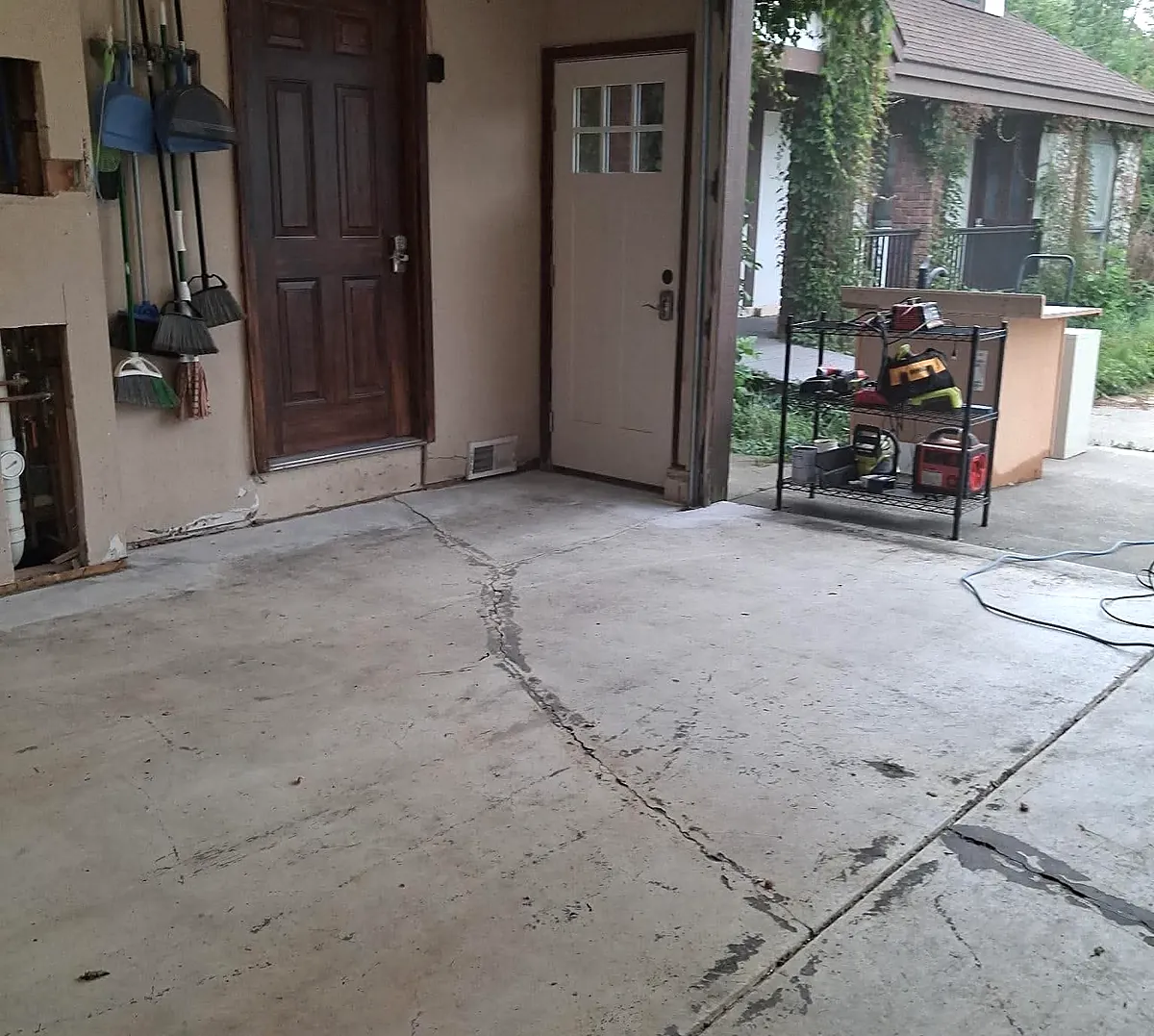
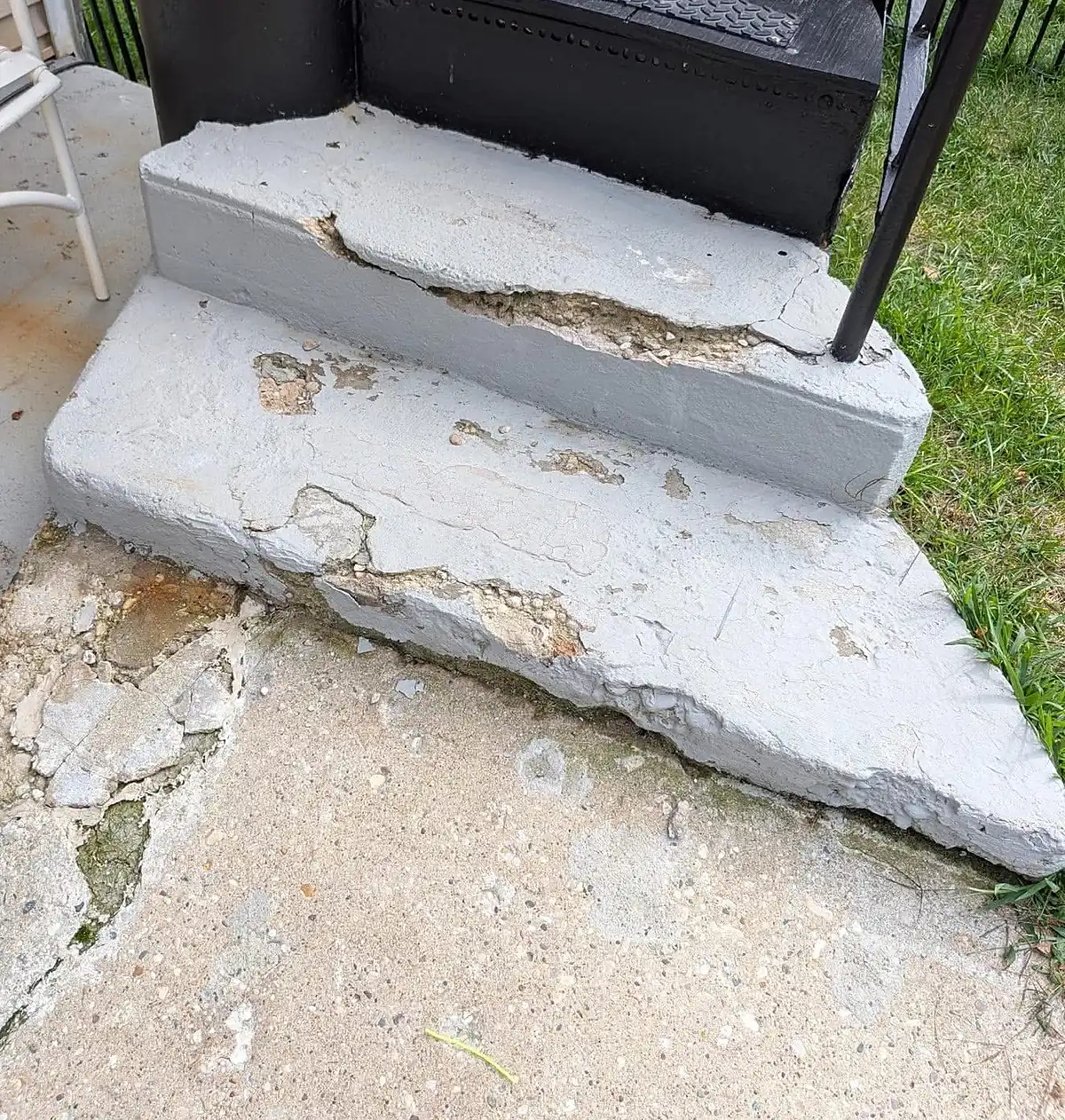
Those steps are not a floor and we are not offering to fix them — they are here because they show, better than any diagram, what happens when a coating sits on top of concrete instead of being ground into it. Water gets underneath, freezes, and takes the surface with it.
02 — The sequence
Five stages, in this order, every time.
Look at the slab
Before anything is quoted, the concrete gets looked at properly: how sound it is, where it has cracked, what has soaked into it, and whether moisture is coming up through it. A basement or an old garage can carry moisture that will push a coating back off, and that has to be known first rather than discovered afterwards.
Grind it
A diamond grinder runs the whole slab with dust extraction attached, cutting off the closed troweled surface and any old coating, sealer or paint still stuck to it. The floor comes up uniformly opened, so the resin has something to key into. This is the stage a hardware-store kit skips, and it is the reason those kits peel.
Repair and prime
With the floor open, cracks, pitting and spalled edges get filled and cut back flush. Then the base coat goes down, wet, across the prepared concrete — this is the layer that bonds the whole floor to the slab.
Broadcast the flake
While the base is still wet, the flake is thrown by hand across it and kept going until the surface will not take any more. Working to refusal like this is what gives an even field with no thin patches and no visible edges between passes.
Scrape back and clear coat
Once it has set, the loose flake is scraped off and the surface knocked flat, then the clear coat goes over the top and seals the chip in. That top layer is what you walk on, wash, and park on — and how long you need to stay off it is something we'll tell you for your specific floor when we quote it, not a number invented on a website.
03 — When to do it
Indoors, so the season doesn't stop it. But before the snow is easier.
Epoxy cures inside a closed building, so this is not summer-only work — a garage or a barn can be coated well into the cold months.
What does change with the season is everything around the job. Before the snow, a garage is easier to empty out, a barn is easier to get equipment into, and you are not driving a salted vehicle back onto a floor that has only just gone down. If the slab is on your list for this year, it is worth getting looked at now rather than in February.
Send a photo of the slab.
A picture of the concrete and a rough size is usually enough to tell you what it needs and what it will take.